
How long does custom metal fabrication take depends on four things far more than on the shop’s calendar: whether the material is on hand, how many operations the part requires, how many approvals sit between quote and release, and whether the drawing changes after work begins. A simple cut-and-form part in stocked material moves quickly. The same part in a specialty alloy, with a finishing step and two rounds of approval, takes considerably longer. Understanding which stages your job actually passes through is the fastest way to get a realistic date.
What Are the Stages Between Quote and Delivery?
Nearly every fabricated part moves through the same sequence, even when some stages are brief.
Quote and Drawing Review
The drawing gets reviewed for anything that will cause a problem downstream, and questions come back. This stage is short when the drawing is complete and long when it is not, which is the earliest place a timeline slips.
Material
If the material is in stock, this stage takes no time at all. If it has to be ordered, the mill or supplier lead time becomes part of your lead time, and it is entirely outside the shop’s control. Specialty alloys, unusual thicknesses, and specific grades are where this stage grows.
Cutting
The flat profile gets cut, typically on a laser or a water jet. The machine is shared across jobs, so your part enters a queue.
Forming
Bends get made, which requires the right tooling and a setup for your part. Setup time is roughly the same for one part or fifty, which is why quantity affects per-part cost more than total duration.
Welding and Assembly
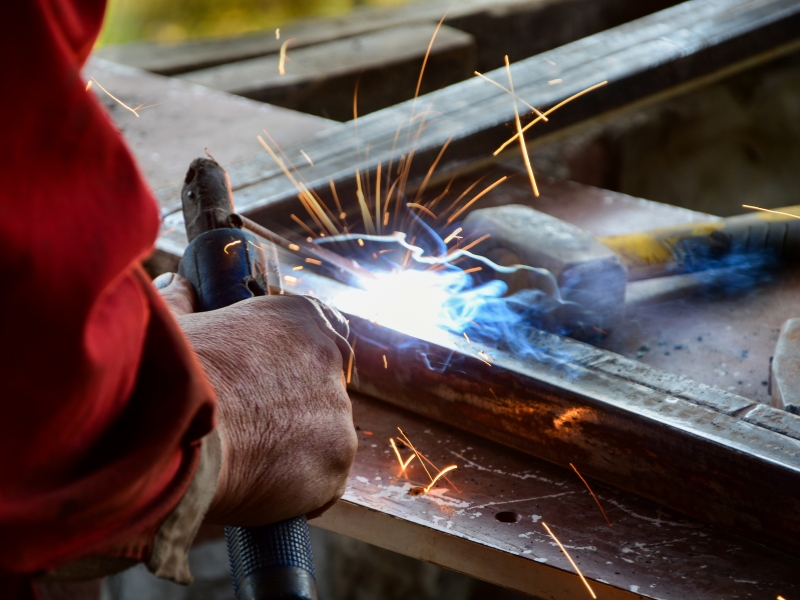
Components get joined, and fixturing may be needed to hold position. On a complex assembly this is often the longest hands-on stage, and it is difficult to compress by adding people.
Finishing
Grinding, polishing, deburring, or coating. Coating adds real time when it goes out for plating or powder coat and enters someone else’s schedule.
Inspection and Delivery
Parts get checked against the drawing before they ship. This is quick on a job that has gone smoothly, and it is the stage nobody should want shortened.
What Actually Drives the Timeline?
Material availability is the biggest single variable and the one most often invisible to the customer. A part that could be made in a day sits idle for weeks if the stock has to come from a mill.
Operation count is next. Each additional process step adds handling, queue time, and a place for the job to wait. A part that is cut and shipped moves faster than one that is cut, formed, welded, machined, and coated, even though every individual step is short.
Finishing that leaves the building matters more than people expect, because your job is now in another shop’s queue. Quantity affects duration less than most buyers assume, since setup dominates on small runs. And current shop load is real, though a well-run shop should tell you what it means for your date rather than absorbing it silently.
Which Delays Come from Your Side?
A meaningful share, and these are the ones you can actually control.
Incomplete drawings stall a job before it starts, because the shop cannot cut material against an unanswered question. A job waiting on a signature is not moving either. Revisions after release are the most expensive, since completed work may have to be redone. Late equipment changes do the same on kitchen and interior projects, where a piece is sized to something that then gets swapped.
The single most useful habit is confirming the things a fabricator will size to, appliances, mating components, wall dimensions, before fabrication begins rather than during.
How Long Does Custom Metal Fabrication Take for a Rush Job?
Faster than a standard schedule when the conditions allow it, and the conditions are specific rather than a matter of effort.
A rush works when the material is on hand, the drawing is complete and released, the part does not need an outside finishing step, and the shop has capacity to reprioritize. Take any one of those away and the compression available shrinks. Material that has to be ordered cannot be rushed by the fabricator at all, no matter how the job is prioritized.
What a shop can genuinely do is move your job to the front of its own queue and run stages back to back. That is a real advantage with real limits. Ask what is specifically possible for your part rather than whether a date can be met.
How Do You Protect a Fixed Date?
Say the date at the quote stage rather than after the order. A fabricator who knows your deadline can sequence around it and flag early if it looks tight, which only helps while there is room to adjust.
Send complete drawings the first time. Confirm equipment models and field dimensions before release. Decide finishes up front, since a late finish change can add a stage that did not exist in the original plan. Agree on who approves what, so the job is not waiting on an unclear decision. And ask to be told the moment something slips rather than at the end, because a delay you hear about early is usually still solvable.
Getting an Update On Your Stainless Steel Project
Drawings or a model, material and thickness, quantity, finish requirements, and the date you need parts in hand. Note anything already fixed, such as an equipment model or an opening date, since those constrain the schedule more than the fabrication does.
With that in front of them, a shop can give you a date it means rather than a range that protects it.
Common Questions About Fabrication Lead Times
Does a smaller order finish faster than a large one?
Somewhat, though less than expected. Setup time is similar either way, so the difference between one part and twenty is often smaller than the difference between one operation and four.
Can a job be split so some parts ship early?
Often yes, and it is worth asking when you need something on site to keep other work moving. Partial shipments have to be planned rather than requested late.
What is the fastest way to shorten my own lead time?
Complete drawings and quick approvals. Those two remove more delay than any other change a customer can make.
Working Against a Deadline?
Send us your drawing and the date you need parts in hand, and we’ll follow up with a clear quote and a straight answer, fast.