
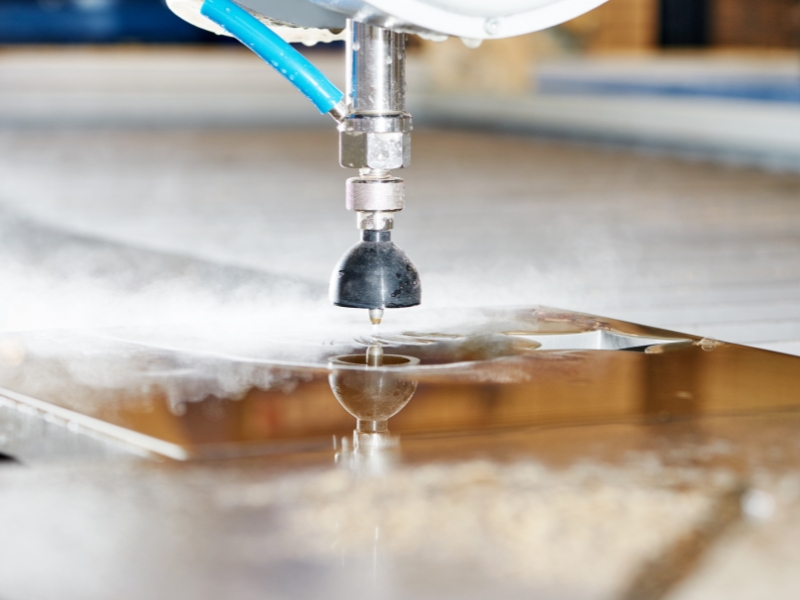
Knowing when to use water jet cutting comes down to reading a few signals in your own drawing. The process cuts with pressurized water and abrasive rather than heat, so it earns its place whenever heat would damage the part, the material is thick, the geometry is complicated, or the job involves something other than sheet metal. On thin steel in high volume, another process is usually faster and cheaper. Here is how to tell which situation you are in before you request a quote.
When to Use Water Jet Cutting: What You Should Look for in Your Drawing
Five things push a job toward water jet, and most parts that belong there show at least two of them. Run through your drawing and see how many apply.
Does Your Part Need to Stay Cool?
This is the strongest signal. Water jet cutting is a cold process, so there is no heat-affected zone along the edge and no change to the temper, hardness, or grain structure of the material next to the cut.
That matters on hardened and heat-treated material, where a thermal process can undo the treatment right where the part is most likely to be loaded. It matters on parts with critical requirements near the cut edge. And it matters on plastics, composites, and laminates that melt, char, or delaminate under heat. If your material was heat-treated on purpose, cutting it cold protects the work already done.
Is the Geometry Complicated?
Water jet cutting follows intricate profiles without tool wear changing the result partway through a run. Interior cutouts, tight radii, sharp interior corners, and nested shapes all cut cleanly, and the tenth part matches the first. There is no tooling to make, which is why one-off and short-run work with complex outlines often lands here even when the material would be easy to cut another way.
Is the Material Thick?
Thermal cutting processes lose speed and edge quality as material gets heavier. Water jet slows down as well, but the edge stays consistent, so on heavy plate it frequently becomes the practical choice even when another process could technically make the cut. If your part is plate rather than sheet, water jet is worth pricing.
Does the Job Involve More Than One Material?
Water jet cutting is close to material-agnostic. Stainless, aluminum, mild steel, copper, titanium, stone, glass, composite, rubber, and foam all run on the same machine. When a project includes gaskets alongside metal parts, or a stone or composite element next to a fabricated bracket, consolidating those cuts onto one process removes a vendor and a handoff from the schedule.
Does the Edge Need to Be Clean Off the Machine?
Water jet leaves a matte, sandblasted edge with very little burr, which often means no deburring step at all. On parts where secondary finishing would otherwise eat labor hours, that changes the total cost even when the cutting itself is slower. For stainless work in particular, an edge that needs no rework is worth quoting against a faster process that does.
Which Process is Right For You?
Being straight about this makes the rest of the guidance more useful. Water jet is not the answer for thin sheet metal in production volume, where thermal cutting is meaningfully faster and cheaper per part. It is not the answer when the part is simple, the material is ordinary, and quantity is high. And it is not the answer when a formed or machined feature would be a better way to get the geometry than cutting it.
If your job is thin, simple, high volume, and made of standard steel, price it both ways and let the numbers decide.
Common Questions About When to Use Water Jet Cutting
Does water jet cutting warp parts?
Not from heat, since none is introduced. That is one of the main reasons flat parts with tight flatness requirements are cut this way.
Will the cut edge need finishing?
Often not. The edge comes off matte with minimal burr. Whether it needs further work depends on the appearance standard the finished part has to meet.
Can water jet cut material that is already painted or coated?
Generally yes, since there is no heat to burn or blister a coating. Tell us about the coating when you request a quote so it factors into setup.
How do I know if my part is a water jet job?
Send the drawing with material, thickness, quantity, and any heat treatment or coating noted. Those details make the process choice obvious quickly.
Have a Part That Cannot Take Heat?
Send us your drawing or DXF, and we’ll follow up with a clear quote for water jet cutting, fast.