
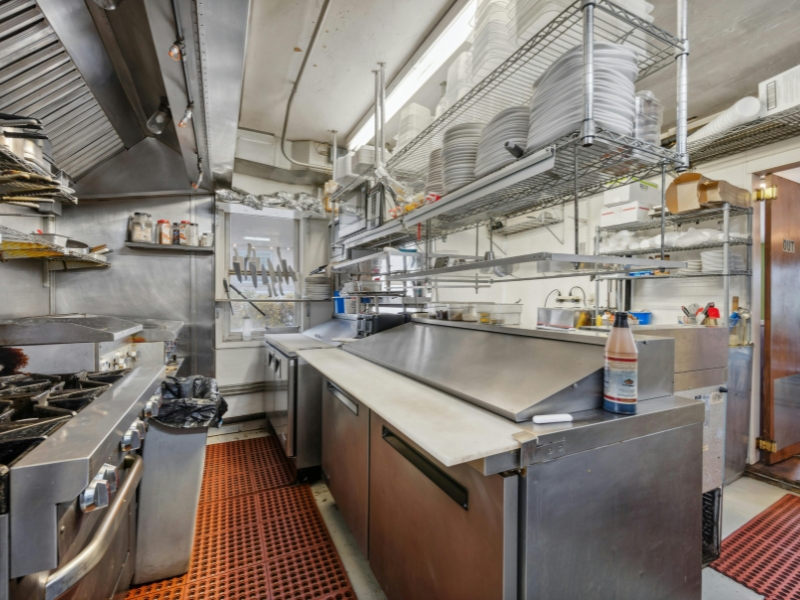
Why stainless steel is used in commercial kitchens comes down to a surface that absorbs nothing, tolerates heat, survives industrial cleaning chemicals, and can be repaired instead of replaced. A working kitchen puts more stress on its surfaces in a year than a home kitchen does in a decade, and most materials that look fine in a showroom cannot take it. Stainless can, which is why it became the standard long before it became a design choice.
What Is a Commercial Kitchen Doing to Its Surfaces?
It helps to be specific about the abuse, because that is what the material selection is answering.
Heat arrives constantly, from pans set down straight off a burner and from equipment radiating all service. Moisture never fully leaves, between washdowns, steam, and splash. Cleaning chemicals are far more aggressive than anything used at home, applied several times a day. Volume means hundreds of contacts per surface per shift. And impact happens, because full hotel pans and stock pots get set down hard by people moving fast.
Any surface in that room is being tested on five fronts at once, every day, for years.
Why is Stainless Steel Is Used in Commercial Kitchens Rather Than the Alternatives?
Nonporous
It means there is no structure in the surface for liquid or residue to enter. Raw protein juices, oil, acid from citrus and tomato, and cleaning solution all stay on top of the metal until they are wiped away. Porous surfaces need a sealer to imitate that, and a sealer is a consumable that degrades with heat and chemicals. Stainless has no layer to lose.
Heat Tolerance
More than a kitchen produces. Hot pans set directly on a stainless surface do not scorch it, discolor it permanently, or weaken it. Surfaces next to fryers and ranges hold their shape through years of thermal cycling, which is where laminates delaminate and sealed stone develops cracks near seams.
Commercial Cleaning Chemicals
Yes, which is a bigger deal than it sounds. Degreasers and sanitizers used in food service are far harsher than household cleaners, and they are applied constantly. Stainless tolerates that routine without the surface breaking down. The main exception is chlorine bleach left sitting, which can pit the surface and should be rinsed rather than allowed to dry.
Damage
It can usually be repaired in place. Scratches blend into a brushed finish or can be worked back along the grain. A dented section can be replaced without tearing out the run beside it. A worn edge can be re-welded and polished. Compare that to a chipped stone counter or a delaminated laminate top, where the practical answer is replacement.
What Does “Stainless” Actually Mean?
It is an alloy, not a coating. Chromium in the steel reacts with oxygen to form a thin passive layer across the surface, and that layer is what resists corrosion. The useful part is that it reforms on its own when the surface is scratched, so a scuff does not create a permanent weak spot the way a break in a coating does.
Stainless resists rust rather than being immune to it. Most rust-colored spotting people find on a stainless surface is contamination from another metal left sitting there, such as a steel wool pad or a cast iron pan, and it cleans off without the stainless underneath being affected.
Where Does Fabrication Quality Show Up?
The material only delivers if the piece is made well, and this is where kitchens differ most.
Welded seams that are ground and polished smooth leave nothing to trap residue. Coved corners are easier to clean than square internal corners. Surfaces sloped toward a drain clear water instead of holding it. Edges that turn down rather than ending in a raw cut are safer and hold their shape. Pieces fabricated to the room’s real dimensions close the gaps where standard equipment leaves an unreachable strip along a wall.
Two kitchens can be built from the same material and clean very differently depending on how the pieces were fabricated.
What Doesn’t Stainless Steel Solve?
It scratches, and in a commercial kitchen it will, quickly. The finish develops a working patina within months, which is normal and does not affect performance. It shows water spots in hard water areas unless surfaces are dried. It dents under heavy impact. And it does nothing about a poor layout, because the best surface in the world still fails if the station it sits in makes people reach across a hot line.
Common Questions About Stainless Steel in Commercial Kitchens
Does stainless steel harbor bacteria?
The surface is nonporous, so there is nowhere for residue to soak in, which is why it is the standard for food contact surfaces. Cleaning practice still does the real work, and seam and corner quality affects how easy that is.
Why do some kitchens have stainless that looks worse than others?
Usually a combination of finish choice, water hardness, and cleaning method. Abrasive pads used across the grain and chlorine cleaners left to dry account for most of the damage people blame on the metal.
Is thicker stainless always better?
Heavier material resists denting and feels more solid, and it costs more. The right choice depends on the piece, since a prep table takes different abuse than a wall panel.
Can stainless surfaces be added to a kitchen that is already running?
Yes. Individual pieces can be fabricated to match existing dimensions and finish and installed around service hours, which is far easier than replacing a full run.
Outfitting a Commercial Kitchen?
Send us your layout and equipment list, and we’ll follow up with a clear quote, fast.