
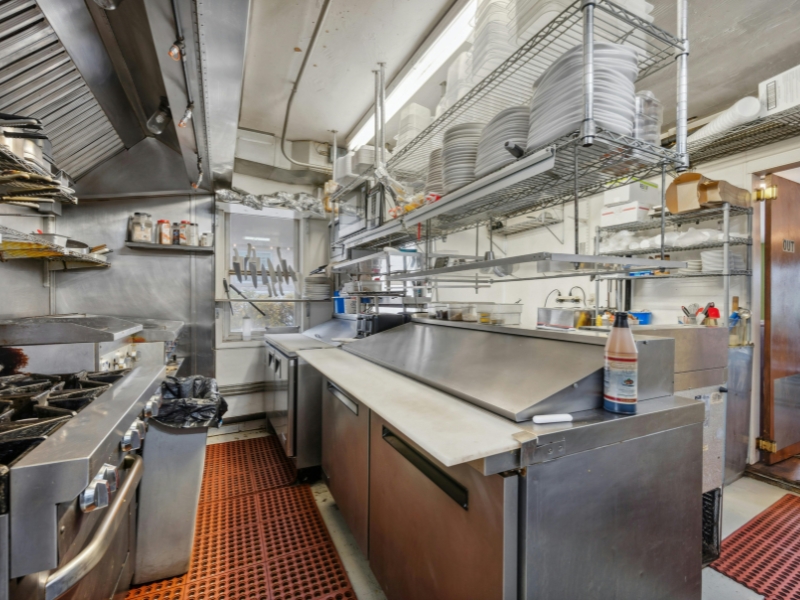
The benefits of stainless steel countertops come down to a surface that does not absorb anything, does not need sealing, and does not flinch at heat. Add custom fabrication and you get one more advantage a prefabricated counter cannot offer: the countertop is made to your measurements instead of your layout being adjusted to fit a stock size. That combination is why the same material turns up in restaurant prep lines and in home kitchens where the owner cooks seriously. Here is what each of those advantages actually means day to day.
What Are the Main Benefits of Stainless Steel Countertops?
A few properties do most of the work here, and they reinforce each other.
Nonporous
Yes, and that single property drives most of the rest. There is nowhere for liquid, oil, or bacteria to soak in, so red wine, lemon juice, tomato, and raw chicken all sit on top of the surface until they are wiped away. Porous surfaces like natural stone rely on a sealer to imitate that behavior, and a sealer wears down over time. Stainless has no coating to lose.
Heat Tolerance
You can set a hot pan directly on it. Stainless steel does not scorch, discolor, or weaken from the kind of heat a kitchen produces, which is why professional kitchens standardized on it long before it became a residential look. No trivet requirement, and no worrying about a cast iron pan leaving a permanent ring.
Low Maintenance
No. Upkeep is soap, water, and drying to avoid water spots, plus an occasional stainless cleaner if you want the finish to look even. Nothing gets resealed on a schedule and nothing needs a specialty product. Across years, that difference adds up more than most people expect when they are comparing surfaces in a showroom.
Where Does Custom Fabrication Change the Answer?
This is what separates a fabricated counter from a prefabricated one, and it is where most of the value lives on a real project.
What Can Be Fabricated Into the Countertop Itself?
Sink bowls can be welded in and polished so there is no rim to trap crumbs. Drainboards can be formed directly into the surface with a slope toward the sink. Backsplash lips can turn up the wall as one continuous piece rather than a separate strip caulked into place. Cooktop and faucet cutouts land exactly where your appliances land. Each of those is a spot where a standard counter forces a compromise.
What Happens When the Walls Are Not Square?
Almost no room is perfectly square, and older buildings are worse. A fabricated counter is cut to measurements taken in your space, so an out-of-square wall becomes a dimension on the drawing instead of a gap you fill with caulk. The same goes for an island with an angle, a peninsula that has to clear a doorway, or a prep run that steps around equipment already in place.
Which Finish Should You Choose?
Finish changes both how the counter looks and how it wears, so it is worth making a deliberate decision rather than defaulting.
A brushed finish is the common choice. Its directional grain hides fingerprints and the fine scratching any working surface picks up.
A polished finish reflects light and reads as a feature surface, which suits a bar or an island more than a heavy prep area.
A textured finish hides wear best and is often specified for high-traffic commercial counters.
Flexible Applications
The demands overlap more than people assume. Both see heat, standing water, acidic food, and repeated cleaning. A restaurant just compresses years of that into months. A homeowner outfitting an outdoor kitchen adds weather and temperature swings on top of normal use, and the same material answers all three. Restaurants tend to specify heavier materials and simpler finishes, while residential projects lean toward edge profiles and integrated details, but the surface underneath does the same job.
What Does Stainless Steel Not Do Well?
Worth being straight about. It shows fine scratches, most noticeably in the first year, and a brushed finish absorbs them better than a polished one. A heavy impact can dent it in a way stone will not. Fingerprints show on polished finishes. And in a kitchen designed around warm traditional materials, a large expanse of stainless can read cold unless wood, stone, or color balances it elsewhere in the room. None of that is a dealbreaker. It is just worth knowing before you commit.
Common Questions About the Benefits of Stainless Steel Countertops
Do stainless steel countertops scratch?
Yes, and most owners describe the result as a patina rather than damage. Fine scratches accumulate early, then stop registering as they blend into the overall surface, particularly on a brushed finish.
Can a sink be part of the countertop itself?
Yes. An integrated sink is welded into the counter and the seam is polished out, so there is no rim or joint where debris collects. It is one of the more common reasons people choose fabricated stainless over a prefabricated surface.
Are stainless steel countertops only for modern kitchens?
No. Finish and edge profile carry most of the visual weight. A brushed finish with a rolled edge alongside wood cabinetry reads far warmer than a polished square-edge counter in an all-white kitchen.
How long do stainless steel countertops last?
Decades, with normal care. The surface changes appearance as it picks up a patina, but it does not degrade the way a sealer or a coating does, and there is no point at which it has to be refinished to keep working.
Thinking About a Stainless Counter?
Send us your layout, and we’ll follow up with a clear quote for custom stainless steel countertops, fast.